
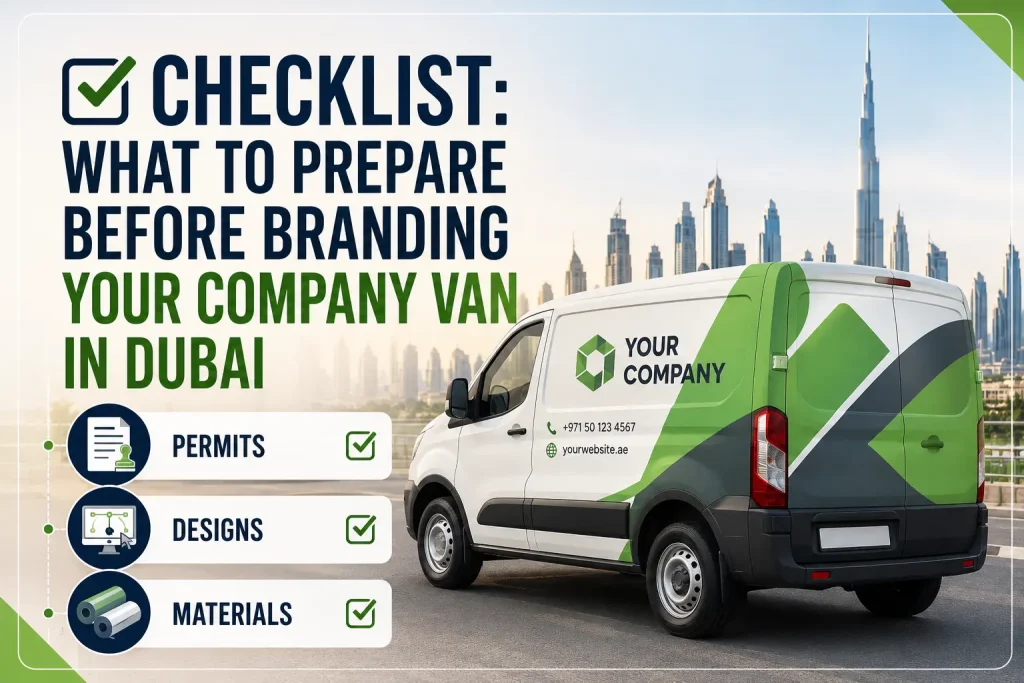
If you’re planning to brand your company van in Dubai, good preparation is the difference between a smooth approval process and costly rework. This guide walks you through a practical checklist—permits, designs, and materials—so you can approach van branding in Dubai like a pro, even if it’s your first time.
Why Preparation Matters for Van Branding in Dubai
Dubai’s roads are crowded with branded vehicles, from delivery vans to service fleets. That means your van wrap is not just a design decision; it’s a regulatory, safety, and long‑term brand investment decision.
A clear checklist helps you:
Avoid RTA and other regulatory violations.
Prevent delays in approvals and installation.
Ensure the wrap actually works as a marketing asset, not just decoration.
Step 1: Clarify Your Branding Objectives
Before you talk to any vehicle wrapping provider in Dubai, you need internal clarity.
Ask yourself:
What is the primary purpose of this van branding?
Brand awareness?
Lead generation?
Reputation and trust?
Who should notice the vehicle?
B2B decision makers in industrial areas?
Residential customers in neighborhoods?
What action do you want them to take?
Call a number, visit a website, scan a QR code, search your brand name?
Write down:
A one‑sentence brand positioning statement.
1–2 key messages to display (not more).
The single most important CTA (e.g., website URL, WhatsApp number, QR to landing page).
This clarity will guide your design, copy, and layout choices.
Step 2: Gather Brand Assets and Design Inputs
A common mistake in vehicle branding in Dubai is starting design work with incomplete brand assets. That leads to inconsistent visuals across vans, social media, and website.
Prepare the following before briefing any designer or agency:
Logo files
High‑resolution vector formats (AI, EPS, SVG, PDF).
Monochrome versions (for certain backgrounds or reflective vinyl).
Brand color codes
CMYK and RGB/HEX codes to ensure consistent printing.
Any “do not use” colors that clash with your brand or reduce readability.
Typography
Primary and secondary fonts.
Clear rules: which font for headlines, which for contact details.
Brand imagery
Approved product photos, lifestyle images, or icons.
Ensure you have rights to use them in large outdoor formats.
Copy and CTAs
Short headline (5–7 words maximum).
Supporting line if needed (again, short and clear).
Website, phone number, QR code URL, social handle (choose 1–2, not everything).
The rule: less text, bigger elements, higher readability at speed.
Step 3: Collect Accurate Vehicle Specifications
Van branding in Dubai becomes painful when the designer works with generic templates instead of accurate van data. Small errors in measurements lead to distorted logos, cut‑off text, or misaligned graphics.
Prepare:
Exact make, model, year, and variant
Example: Toyota Hiace Panel Van, 2022, LWB, specific roof type.
High‑quality photos
Front, rear, left side, right side, and top (if relevant).
Avoid heavy perspective distortion; shoot as straight as possible.
Dimensions and details
Overall length, height, width.
Positions and sizes of doors, windows, handles, fuel cap, lights, badges, sensors.
Most experienced vehicle wrapping providers in Dubai will have digital templates, but your photos and notes help them place critical elements (logo, CTA, QR) away from panel gaps and curves.
Step 4: Understand Regulatory Requirements and Approvals
Vehicle branding in Dubai is not just about design; it must comply with local regulations. While exact rules can change, it’s smart to prepare for:
Regulatory body approvals
In many cases, commercial vehicle advertising needs approval (e.g., via municipality or transport authority channels).
Some categories (e.g., certain professional services, healthcare, financial services) may have stricter guidelines on messaging.
Content restrictions
Avoid offensive, misleading, or culturally insensitive imagery or text.
Be careful with claims (e.g., “No.1 in Dubai”) without basis.
Placement rules
Some areas of the vehicle (such as windows, windshield, license plate, and lights) cannot be fully covered.
Perforated film on rear windows may be allowed under specific conditions; check local guidance.
Before you lock your design:
Ask the service provider what approvals are required for your specific vehicle type and activity.
Confirm whether they assist with submission and documentation.
Keep digital copies of your trade license and relevant permits ready.
Step 5: Decide the Coverage: Full Wrap, Partial Wrap, or Decals
Not every business needs a full vehicle wrap in Dubai. Decide coverage based on your objectives and budget.
Common options:
Full wrap
Entire van body is wrapped.
Maximum visual impact and color control.
Better if your brand color is far from the original paint.
Partial wrap
Strategic areas (sides + rear) are wrapped.
Cost‑effective for SMEs and startups.
Works well when base van color matches brand palette.
Cut vinyl decals
Logos, contact info, and simple graphics applied directly.
Lowest cost and simplest to update.
Prepare:
A rough idea of your preferred coverage before the design phase.
A realistic budget range so your provider can recommend the best mix of impact and cost.
Step 6: Choose the Right Materials for Dubai’s Climate
Vehicle wrapping in Dubai faces harsh sunlight, high temperatures, sand, and occasional humidity. Material quality directly affects how long your van branding looks fresh.
Discuss and decide on:
Vinyl type
Cast vinyl vs. calendered vinyl (cast is more durable and better for curves, usually more expensive).
For long‑term fleet branding, higher‑grade cast vinyl is often worth the investment.
Lamination
UV‑resistant laminates to protect against fading.
Gloss, matte, or satin finish depending on your brand personality and readability.
Special films (optional)
Reflective films for night visibility (safety + branding).
Textured or metallic films if they fit your brand and budget.
Ask the provider:
Expected lifespan of the wrap under typical Dubai conditions.
Warranty terms for fading, peeling, or cracking.
Recommended cleaning methods to preserve the material.
Step 7: Plan the Design for Real‑World Visibility
On Dubai’s fast roads, a beautiful design is useless if people can’t understand it in 2–3 seconds.
When reviewing your van branding design:
Prioritize hierarchy
Brand name or logo: most prominent.
Key message: secondary.
CTA: clear and easy to find.
Test readability
Print the design on an A4 sheet and stick it on the wall.
Step back 3–4 meters; can you still read the main message?
Simulate movement—do a quick glance; what do you remember?
Mind the background and contrast
Use high contrast between text and background.
Avoid busy patterns behind important text.
Respect the van’s shape
Avoid placing important elements on curves, door gaps, or near handles.
Check how design flows across panels when doors are opened and closed.
Always ask for multiple mockups:
Left, right, front, rear views.
Daytime and low‑light simulations if available.
Step 8: Prepare Legal and Administrative Documents
Before installation, most professional vehicle branding providers in Dubai will ask for documentation.
Prepare:
Trade license copy.
Vehicle registration (Mulkiya) copy.
Proof of ownership or authorization (if leased or rented).
Company stamp and authorized signatory details (for forms/approvals).
Having these ready shortens lead time from design approval to installation.
Step 9: Schedule Installation Smartly
Vehicle wrapping in Dubai requires controlled indoor conditions for best results. Rushing the process or choosing a poor time can impact quality.
Plan for:
Downtime
Typically, 1–3 days depending on coverage and number of vans.
Coordinate with operations to minimize disruption (weekends, off‑peak days).
Pre‑installation cleaning
Ensure the van is thoroughly washed and dried (no wax or polish).
Remove accessories (roof racks, external attachments) if agreed in advance.
On‑site vs. in‑shop installation
In‑shop is usually better due to controlled environment.
If you require on‑site work (e.g., fleet in yard), confirm if they bring tents or climate control solutions.
Clarify:
Who is responsible for removing existing graphics or old wraps.
Whether any paintwork issues might affect adhesion (e.g., repainted panels, body repairs).
Step 10: Create a Maintenance and Inspection Routine
Vehicle branding is not a one‑time project; it’s an asset that needs care.
After your van branding is complete:
Train drivers and staff
Basic cleaning dos and don’ts (no harsh chemicals, no high‑pressure water directly at edges, avoid abrasive brushes).
Parking awareness (whenever possible, avoid long exposure in direct sunlight).
Set up a basic inspection schedule
Monthly visual checks for peeling, bubbles, lifting edges.
Quick photo documentation if issues appear (for warranty claims and quick fixes).
Plan for updates
If contact details, websites, or offers are likely to change, plan how you’ll update those portions without redoing the full wrap.
This helps maintain professional appearance and extends the wrap’s useful life.
Quick Pre‑Branding Checklist (Summary)
Before you move ahead with van branding in Dubai, confirm you have:
Clear objectives and key messages.
Complete brand assets (logo, colors, fonts, images, copy).
Accurate vehicle specs (model, photos, measurements).
Understanding of required approvals and basic regulations.
Decision on coverage (full wrap, partial, decals) and budget range.
A design tested for readability and visibility in real conditions.
All legal documents ready (trade license, registration, authorization).
Scheduled installation time with realistic vehicle downtime.
A maintenance and inspection routine planned.