
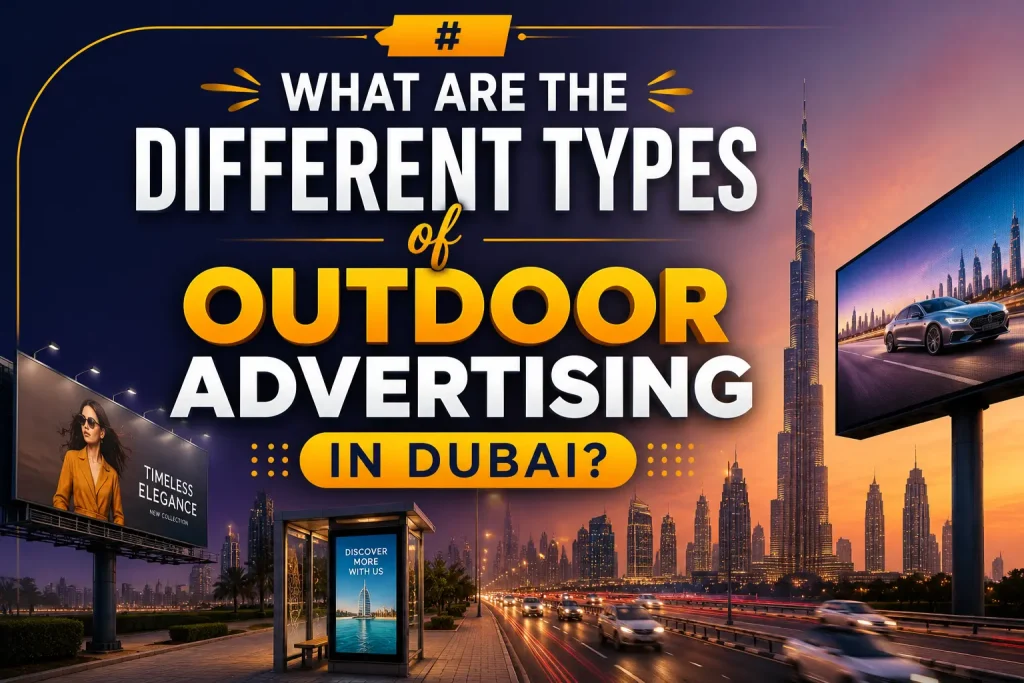
Dubai is a city where brands compete for attention across highways, business districts, residential communities, shopping destinations and tourist areas. From large roadside billboards to illuminated lamp post displays, outdoor advertising has become an important part of the city’s visual landscape.
But outdoor advertising in Dubai is not limited to traditional billboards. Businesses can choose from several out-of-home (OOH) advertising formats, each designed for a different audience, location and campaign objective.
The right format depends on what you want to achieve. A large unipole may be suitable for a brand looking for long-distance visibility, while lamp post advertising can provide repeated exposure along a specific route. Digital screens offer flexibility, while traditional static formats can provide consistent visibility over a longer campaign period.
In this guide, we explain the main types of outdoor advertising in Dubai, how they differ, and how businesses can choose the right format for their campaigns.
What Is Outdoor Advertising?
Outdoor advertising, also known as out-of-home advertising or OOH advertising, refers to advertising that reaches people while they are outside their homes. It includes physical advertising formats placed along roads, in public spaces, transport environments, commercial areas and other locations where people travel or spend time.
In Dubai, OOH advertising includes formats such as billboards, unipoles, lamp post advertising, digital screens, transport advertising and other location-based media. Dubai’s current OOH framework also classifies advertising according to factors such as the type of advertisement, location and how information is delivered to users.
The variety of formats gives businesses the opportunity to choose outdoor media based on their campaign goals rather than using the same format for every situation.
Why Are There Different Types of Outdoor Advertising in Dubai?
Different outdoor advertising formats solve different marketing problems.
For example:
A billboard can create large-scale brand visibility.
A unipole can provide elevated visibility along major roads.
Lamp post advertising can create repeated exposure along a particular route.
Digital OOH allows advertisers to change creative and schedule messages.
Transport advertising can take a brand message across different parts of the city.
Airport advertising can reach an international audience at key travel touchpoints.
Location, audience, viewing distance, campaign duration and creative requirements all influence which format is most appropriate.
1. Billboard Advertising
Billboards are one of the most recognisable forms of outdoor advertising in Dubai.
They are generally large-format advertising displays positioned along major roads, highways, commercial areas and other high-traffic locations. Static and digital billboard formats are available in the wider Dubai OOH market.
Why businesses use billboards
Billboards are particularly useful for:
Building brand awareness
Product launches
Large-scale campaigns
Event promotions
Reaching motorists and commuters
Maintaining continuous brand visibility
Because of their size, billboards can communicate a brand message from a considerable viewing distance.
However, a billboard is not automatically effective simply because it is large. Location and creative execution matter just as much as the physical size of the advertising space.
A billboard on a high-traffic route with strong visibility can have a very different impact from one in a lower-traffic location.
2. Unipole Advertising
Unipoles are elevated outdoor advertising structures designed to provide strong visibility above surrounding traffic and structures.
They are commonly positioned along major roads, highways and important intersections. Their elevated position can give advertisers a longer sightline compared with many ground-level advertising formats.
Unipole advertising can be particularly useful for:
Automotive brands
Real estate companies
Luxury brands
Retail businesses
Corporate campaigns
Large-scale brand awareness
The design should be simple and easy to understand because motorists often have only a short amount of time to see the advertisement.
For a campaign targeting drivers travelling between major areas, a strategically positioned unipole advertisement in Dubai can provide strong repeated exposure.
3. Lamp Post Advertising
Lamp post advertising uses advertising panels attached to street lighting poles along roads and urban routes.
Unlike large billboards, lamp post advertisements are generally positioned closer to street level. This makes them useful for creating repeated visibility along a particular route.
Businesses can use lamp post advertising for:
Retail campaigns
Brand awareness
Events
Tourism promotions
Community-focused campaigns
Location-based promotions
One of the main advantages is repetition. Instead of relying on a single large advertising structure, a campaign can use a series of displays along a route so that people encounter the brand multiple times during a journey.
This makes lamp post advertising particularly useful when the objective is to establish a strong presence within a specific area.
4. Digital Out-of-Home Advertising
Digital Out-of-Home, commonly called DOOH, uses digital screens instead of printed advertising surfaces.
Digital OOH has expanded the possibilities of outdoor advertising because advertisers can display changing creative rather than relying on one static message. Digital formats can also support scheduled or time-based campaigns.
For example, a business could use different creative during different periods of the day or update promotional messaging when required.
Digital OOH can be useful for:
Product launches
Time-sensitive promotions
Retail campaigns
Events
Entertainment
Automotive campaigns
Brand awareness
The biggest advantage is flexibility.
However, digital does not automatically mean better. A static billboard in an exceptional location can still be more valuable for certain campaigns than a digital screen in a less relevant location.
5. Static Outdoor Advertising
Not every outdoor advertising campaign needs a digital screen.
Static advertising uses printed creative that remains in place for the agreed campaign period. Billboards, unipoles and lamp post displays can all use static formats.
Static outdoor advertising can work well when a business wants:
Consistent messaging
Long-term visibility
Strong visual branding
A simple campaign message
Predictable creative placement
Static formats can also be easier to design because the message does not need to account for multiple rotating creatives.
The key is to create a design that can be understood quickly from the expected viewing distance.
6. Airport Advertising
Dubai International Airport is an important advertising environment because it connects the city with international travellers, business visitors and residents.
Airport advertising can include digital screens, displays and other media formats positioned within airport environments.
It is particularly relevant to brands targeting:
International travellers
Business executives
Tourists
Premium consumers
Hospitality customers
Financial services
Technology brands
Luxury businesses
Airport advertising is different from roadside advertising because the audience may have more time to engage with the message depending on the placement.
For businesses targeting people arriving in or travelling through Dubai, airport media can form part of a wider OOH strategy.
7. Transport Advertising
Transport advertising places brand messages on or around public and commercial transportation.
Depending on the media network, this can include:
Bus advertising
Taxi advertising
Metro advertising
Tram advertising
Transport station advertising
Transport advertising can extend a campaign beyond one fixed location and help brands reach commuters, residents and visitors across different parts of Dubai. Transport is recognised as one of the broader OOH categories available in the Dubai market.
It can be particularly useful for brands that want mobility and geographic coverage rather than visibility from a single roadside location.
8. Bridge and Roadside Advertising
Bridge banners and other roadside formats are designed to communicate with people travelling along major routes.
Their position can give advertisers strong visibility from approaching traffic, while their horizontal format allows for a different creative approach from traditional vertical structures.
They can be useful for:
Brand awareness
Event campaigns
Product launches
Promotional campaigns
Large-scale messaging
However, roadside advertising needs to be designed specifically for the speed and viewing conditions of the location.
A design that looks good on a computer screen may not work when viewed from a moving vehicle.
9. Building Wraps and Large-Scale Outdoor Media
Building wraps use large surfaces on buildings or structures for advertising.
Because of their scale, they can create a strong visual presence and are often used when a campaign needs to make a major brand statement.
Large-scale formats require careful consideration of:
Viewing distance
Building architecture
Artwork resolution
Message size
Installation requirements
Applicable regulations
Dubai’s OOH framework includes provisions and standards around advertising structures, locations, dimensions and design requirements, so large-scale campaigns need to be planned in accordance with applicable rules.
10. Mall and Retail OOH Advertising
Outdoor advertising is not limited to roads.
Retail environments such as shopping malls can provide controlled environments where brands can reach consumers closer to the point of purchase. Formats may include digital screens, lightboxes, pillar displays and other retail media placements.
These formats can be particularly relevant to:
Fashion brands
Consumer electronics
Beauty brands
Food and beverage businesses
Retailers
Entertainment companies
The major difference is dwell time. People inside a shopping environment may have more time to view and interact with an advertisement than someone driving past a highway billboard.
How to Choose the Right Outdoor Advertising Format in Dubai
There is no universally “best” outdoor advertising format.
The right choice depends on several factors.
1. Define Your Campaign Objective
Start by asking what you want the campaign to achieve.
Is the goal:
Brand awareness?
Product launch?
Event promotion?
Store visits?
Lead generation?
Market entry?
Long-term brand visibility?
Your objective should influence the media format.
2. Consider Your Target Audience
Think about who you want to reach.
For example:
Commuters:
Roadside billboards, unipoles and transport advertising may be relevant.
Tourists:
Airport and major tourist-area advertising can be considered.
Local residents:
Lamp post and community-focused formats may provide stronger geographic relevance.
Business professionals:
Media around business districts and major commuter routes may be appropriate.
3. Look at the Location
Location is one of the most important factors in outdoor advertising.
Consider:
Traffic volume
Direction of travel
Viewing distance
Visibility
Surrounding structures
Audience profile
Nearby destinations
Expected frequency
A smaller advertising format in the right location can sometimes outperform a larger format in a less relevant location.
4. Match the Creative to the Format
A billboard viewed from a highway requires a different creative approach from a mall display.
For roadside advertising, the message should generally be:
Short
Clear
Visually strong
Easy to read
Brand-focused
For environments where people have more time to engage, such as malls or some indoor OOH environments, the creative can contain more information.
5. Consider Campaign Duration
Campaign duration can also influence your choice.
For long-term awareness campaigns, static formats can provide consistent presence.
For short-term promotions or campaigns that require changing messages, digital OOH can provide greater flexibility.
Outdoor Advertising in Dubai: Which Format Is Right for Your Business?
Here’s a simple way to think about the major formats:
| Format | Best Suited For |
|---|---|
| Billboards | Mass visibility and brand awareness |
| Unipoles | Major roads and long-distance visibility |
| Lamp Posts | Repeated exposure along specific routes |
| Digital OOH | Flexible and time-sensitive campaigns |
| Airport Advertising | Travellers and international audiences |
| Transport Advertising | Mobile citywide exposure |
| Bridge Banners | High-traffic routes and large-scale messaging |
| Building Wraps | High-impact brand statements |
| Mall OOH | Retail audiences and higher dwell time |
This isn’t a ranking. Each format serves a different purpose, and the right choice depends on the campaign objective, audience and location.
What About Outdoor Advertising in Sharjah?
The same basic OOH principles apply to outdoor advertising in Sharjah, but the best format depends on the specific road, audience and campaign objective.
Businesses targeting both emirates can consider a combined strategy rather than treating Dubai and Sharjah as completely separate markets.
For example, a campaign could use high-visibility roadside media in Dubai while using location-specific formats in Sharjah to build frequency among local audiences.
The important factor is not simply choosing the emirate with the larger market. It is choosing locations where your target audience is most likely to see the message.
Why Location Matters More Than Format
One of the biggest mistakes businesses make when planning outdoor advertising is choosing a format before considering the location.
A billboard may look impressive, but its effectiveness depends on factors such as:
Where it is located
Who passes it
How frequently they pass it
How long the advertisement is visible
Whether the creative is easy to understand
Whether the location matches the campaign objective
Dubai’s updated OOH framework places considerable emphasis on site planning, traffic safety, spacing, design standards and the strategic distribution of advertising locations.
So the question shouldn’t simply be:
“Which is the biggest billboard I can get?”
A better question is:
“Which outdoor advertising format and location will put my brand in front of the right audience repeatedly?”
Final Thoughts
Dubai offers a wide range of outdoor advertising options, from traditional billboards and elevated unipoles to lamp post advertising, digital OOH, transport media and airport advertising.
Each format has its own strengths.
Billboards can provide large-scale visibility.
Unipoles can dominate major road corridors.
Lamp posts can build repeated route-level exposure.
Digital OOH provides flexibility for changing campaigns.
Airport and transport advertising can connect brands with travellers and commuters.
The best outdoor advertising strategy is therefore not about choosing the most expensive or largest format. It is about matching format + location + audience + creative + campaign objective.
If you’re planning an outdoor advertising campaign in Dubai, understanding these differences is the first step toward choosing media that fits your brand and marketing goals.