
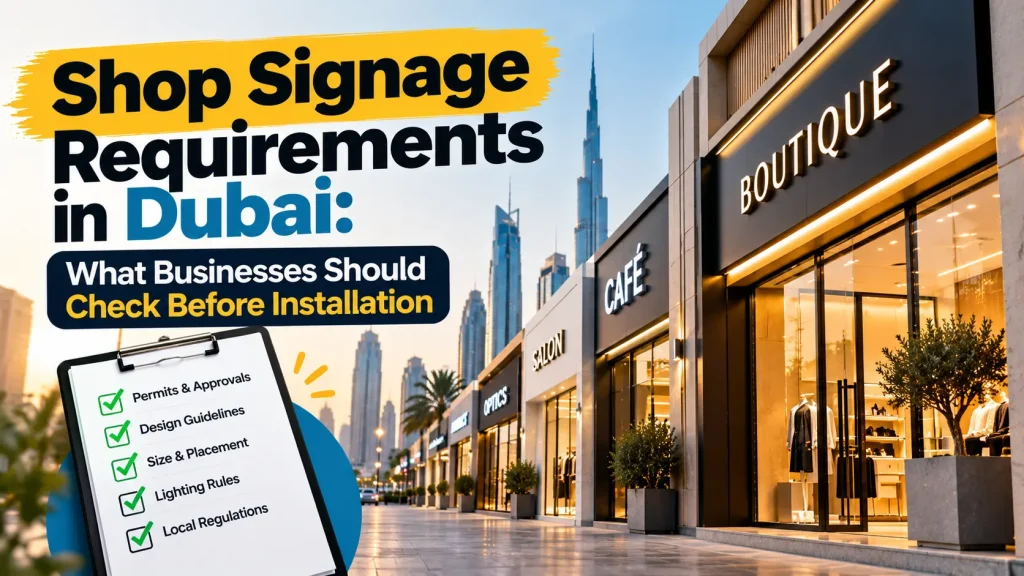
Installing a shop sign in Dubai involves more than choosing a design and fixing it above your entrance. Businesses need to consider signage regulations, the trade name on their licence, the shopfront layout, language requirements, lighting and the approvals applicable to their location.
Getting these details right before production can help avoid redesigns, installation delays and unnecessary expenses. It also ensures that your signage represents your business professionally while meeting the applicable requirements.
Whether you are opening a new retail shop, setting up a restaurant or updating an existing storefront, this guide explains what to check before installing shop signage in Dubai.
What Are the Shop Signage Requirements in Dubai?
Dubai regulates commercial signage to maintain a consistent streetscape, reduce visual clutter and support public and road safety. The rules cover how shopfront signs are displayed, their dimensions, language, lighting and installation.
Dubai’s advertising framework is governed by Decree No. 6 of 2020, while the applicable technical requirements are set out in the relevant out-of-home advertising guidance. Dubai government announcements in May 2026 also reiterated requirements for commercial shopfront signage, including trade-name display, sign placement and restrictions on moving content.
Before installing a sign, businesses should check the following:
Whether an advertising permit or other approval is required
Whether the proposed sign matches the business’s registered trade name
Whether the design follows the applicable language and layout requirements
Whether the dimensions and placement are permitted
Whether the lighting and display format meet the relevant standards
Whether the property owner or building management must approve the installation
Whether additional requirements apply to the sign’s structure, electrical components or location
The exact requirements can depend on the property, sign type and approving authority. A sign inside a shopping centre, for example, may be subject to requirements from the centre’s management in addition to the applicable government rules.
1. Check Which Authority Approves Your Shop Sign
One of the first steps is identifying the authority responsible for approving your proposed signage.
The approval route can vary according to the location of the premises and the type of sign being installed. Dubai’s advertising regulations distinguish between commercial shopfront advertising, advertising in free zones and special development areas, and advertising in locations managed by other authorities.
For a typical commercial shopfront, the relevant process may involve the Dubai Department of Economy and Tourism (DET). Businesses in certain free zones or special development areas may need to apply through the authority responsible for that jurisdiction.
If the sign extends beyond the ordinary shopfront or involves a structure, rooftop, building façade or another advertising format, additional requirements may apply.
Before starting production, confirm:
Which authority handles the application for your premises
Whether your proposed sign requires a new permit or another form of approval
Whether the landlord, shopping centre or master developer must provide a no-objection certificate
Whether structural or electrical documentation is required
Whether the approval must be obtained before installation
Do not assume that a permit issued for another property or a different type of sign will automatically cover your proposed installation.
2. Make Sure the Sign Matches Your Registered Trade Name
Your shop signage should accurately represent the business operating from the premises.
Before preparing the artwork, compare the proposed business name with the name shown on your trade licence. Check the spelling, wording and Arabic and English versions, where applicable.
Dubai’s recent shopfront signage guidance specifies that only one trade name should be displayed on a shopfront under the relevant framework. Multiple trade names or additional advertisements on the same shopfront may not be permitted.
This is particularly important for businesses that want to display several brand names, promotional messages or logos alongside their main shop sign.
If you operate under a registered trade name but also use a separate consumer-facing brand, confirm how the proposed display should be treated before submitting the design.
Practical tip: Finalise the business name and its language versions before requesting the final artwork. Changing the name or layout after production can increase costs and delay installation.
3. Follow the Applicable Arabic and English Layout Requirements
Language placement is an important consideration when designing shop signage in Dubai.
The Dubai government guidance published in May 2026 states that commercial shopfront trade-name signage should be displayed horizontally, with Arabic positioned above English. The guidance also restricts vertical installation of trade-name signage on shopfronts.
Before approving the artwork, check:
The correct Arabic and English business names
The order and placement of both languages
The size and readability of the text
The horizontal orientation of the sign
The applicable dimensions and layout specifications
Do not rely solely on a generic bilingual sign template. The final arrangement should follow the requirements applicable to your particular shopfront and sign type.
If your business uses a registered Arabic trade name, have the wording checked before production. Incorrect spelling or an unsuitable translation can lead to avoidable artwork changes.
4. Check the Permitted Sign Dimensions and Placement
A sign that looks attractive in a design mock-up may not fit the permitted dimensions or installation area.
Dubai’s shopfront signage framework requires sign dimensions to be proportionate to the height and width of the storefront. Excessive height, width or thickness can conflict with the applicable requirements.
Before finalising the design, measure the available shopfront and identify the exact area where the sign will be installed.
Consider the following:
The width and height of the storefront
The proposed sign’s overall dimensions and thickness
The position of doors, windows and other architectural features
The distance between the sign and adjacent shopfronts
Any restrictions imposed by the landlord or building management
Whether the sign will project from the façade
The recent Dubai guidance states that projection is permitted from one side only under the relevant shopfront framework. However, the exact permitted dimensions and installation method should be checked against the applicable technical manual.
Do not assume that a sign approved for one retail unit can be installed at the same size on another property.
5. Understand the Rules for Lighting and Illuminated Signs
Illuminated signage can improve visibility, particularly for shops operating in the evening. However, the brightness, background colour and lighting arrangement must be considered during the design stage.
Dubai’s recent shopfront guidance highlights requirements relating to lighting and brightness. It also advises against bright white backgrounds under the relevant framework.
If you are planning an illuminated sign, confirm the applicable requirements before selecting the lighting system or approving the final artwork.
Check these details with your signage provider:
Whether illumination is permitted for the proposed sign
The approved lighting arrangement and brightness limits
Whether brightness must be measured using an approved instrument
Whether electrical documentation or additional safety information is required
Whether the lighting creates glare or affects nearby properties
Whether the building has restrictions on illuminated signage
LED channel letters, backlit signs and other illuminated formats may have different installation requirements depending on their construction and location.
Avoid treating brightness as purely a design decision. The sign must be suitable for the premises and comply with the applicable technical standards.
6. Confirm Whether Animated or Digital Shop Signage Is Allowed
Businesses sometimes consider digital screens or animated displays to attract attention. However, not every display format is permitted for every type of shopfront signage.
Dubai’s May 2026 guidance states that commercial trade-name shopfront signage under the relevant framework must use static content. Changing or animated content, including videos and moving images, is not permitted for that category of signage.
This does not mean every digital advertising format in Dubai is subject to identical rules. The restrictions must be considered according to the specific sign category and location.
If you are planning a digital screen, scrolling text, animated graphics or video content, verify the applicable rules before purchasing equipment.
A digital format suitable for an approved advertising space may not be suitable as a replacement for a standard shop-name sign.
7. Check Whether Your Shop’s Location Affects the Rules
The location of your business can influence the approval process and the types of signage permitted.
For example, a shop in a shopping mall may have to follow the mall’s signage standards, approved design templates and installation schedule. A business in a managed free zone may need to follow that zone’s application process.
Dubai’s May 2026 guidance also states that trade-name signage must not be placed on building balconies or on the external façades of offices, clinics and commercial outlets located above the ground floor under the relevant framework.
This is particularly important for businesses operating from upper-floor premises.
Before commissioning the sign, ask the relevant authority or property manager to confirm:
Whether your premises are covered by a special development or free-zone authority
Whether the shop is on the ground floor or an upper floor
Which façade or installation area is permitted
Whether the building has a standard signage design
Whether landlord or master-developer approval is required
Whether additional structural or safety requirements apply
Confirming these details early can prevent you from investing in a sign that cannot be installed in the intended location.
8. Prepare the Required Documents Before Applying
The documents required for a shop sign depend on the approving authority and the type of installation.
As an example, the Dubai Development Authority’s advertising permit service lists documents such as a location map, a photograph of the existing façade, scaled drawings of the proposed sign, material specifications, a mock-up showing the sign on the building and a no-objection certificate from the plot owner.
Additional documents may be required depending on the application, including trade licences, contractor appointment letters, structural information, risk assessments or approvals from other relevant authorities.
Use the checklist below to prepare for the application.
| Document or detail | Why it may be needed |
|---|---|
| Business or tenant trade licence | Identifies the business and its authorised activity |
| Location map or site plan | Shows where the sign will be installed |
| Existing façade photograph | Provides a reference for the proposed installation |
| Scaled sign drawing | Shows dimensions and the intended layout |
| Material specifications | Identifies the proposed sign construction |
| Façade mock-up | Shows how the sign will appear on the property |
| Property owner or management NOC | Confirms permission where required |
| Contractor appointment letter | May be required for building signage applications |
| Structural or electrical documents | May be required for certain sign types or installations |
This is a preparation checklist, not a universal list of mandatory documents. Confirm the current requirements with the authority responsible for your premises before submitting an application.
9. Understand Permit Fees and Additional Costs
The cost of obtaining approval is separate from the cost of designing, manufacturing and installing the sign.
Depending on your property and the type of signage, the total project cost may include:
Sign design and artwork preparation
Material and fabrication costs
Printing or illuminated lettering production
Installation and access equipment
Electrical work, where applicable
Permit or application fees
Additional structural or technical documentation
Property management or contractor-related charges
For example, the Dubai Development Authority publishes a fee of AED 500 per year for ground-floor shop signage under its advertising permit service for the free-zone areas it covers. This is a jurisdiction-specific fee and should not be treated as the standard permit fee for every shop in Dubai.
Before approving the project budget, ask your signage provider to separate fabrication and installation charges from any permit-related fees.
Also confirm whether the quotation includes the preparation of drawings, application support and any revisions requested by the authority.
10. Choose the Right Signage Material and Design
Once the regulatory requirements are clear, you can focus on the design and material.
The right choice depends on the building, the business’s brand identity, the intended appearance and the applicable technical requirements.
Common shop signage options include:
3D letter signage: Individual letters mounted on the shopfront to create a dimensional appearance. Depending on the construction, the letters may be illuminated or non-illuminated.
LED illuminated signage: Signage that uses LED lighting to improve visibility. Its suitability depends on the permitted lighting specifications and installation conditions.
Flat panel signage: A panel carrying the business name and branding. The material and mounting method should be suitable for the property and the intended application.
Acrylic signage: Acrylic may be used for letters or panels, depending on the design and installation requirements.
Metal lettering: Metal letters can create a clean, professional appearance and may be suitable for different commercial settings.
Not every material or format will be suitable for every location. Confirm the permitted construction, dimensions, lighting and installation method before placing a fabrication order.
The design should also be easy to read from the intended viewing distance. A clear business name, good contrast and a well-organised layout are generally more useful than excessive decorative elements.
11. Get Property Management Approval Before Installation
Government approval and property-owner approval are separate considerations. Depending on the premises, you may need permission from the landlord, shopping centre, building management or master developer before the sign is installed.
Some properties require businesses to use specific sign dimensions, materials, colours or mounting systems to maintain a consistent appearance across the building.
Before installation, confirm:
The approved installation area
Whether the property has a standard signage specification
The permitted installation time
Whether the contractor needs to register with building management
Whether access equipment or electrical work requires separate coordination
Whether the proposed installation could affect the façade or neighbouring units
Do not assume that receiving one approval automatically removes the need for another. Keep the relevant approvals and final design documents available for the installer.
12. Complete a Final Check Before Manufacturing the Sign
A final review can help prevent costly changes after production begins.
Before authorising fabrication, check the following:
The business name matches the relevant licence and approved artwork.
Arabic and English text follow the applicable layout requirements.
The dimensions have been measured against the actual storefront.
The proposed position and mounting method have been confirmed.
The lighting or display format complies with the applicable rules.
The required permit and property approvals have been confirmed.
The materials and installation method are suitable for the location.
The quotation clearly separates fabrication, installation and approval-related costs.
The installer understands the approved design and any site-specific conditions.
Keep a copy of the final artwork, drawings and approvals. If the design changes after approval, confirm whether the revised version needs further review before installation.
Shop Signage Installation Checklist for Dubai Businesses
Use this checklist when preparing to install or replace a shop sign.
Confirm the authority responsible for your premises.
Check the current requirements for your sign type.
Verify the trade name and Arabic and English wording.
Measure the shopfront and confirm permitted dimensions.
Check the rules for placement, projection and lighting.
Confirm whether digital or animated content is permitted.
Obtain property-owner or building-management approval where required.
Prepare the necessary drawings, photographs and supporting documents.
Confirm the permit process and applicable fees.
Finalise the design and material specifications.
Obtain the required approvals before installation.
Review the completed sign against the approved design.
Frequently Asked Questions
1. Do I need a permit to install a shop sign in Dubai?
An advertising permit or relevant approval may be required, depending on the sign and premises. Dubai regulates advertising through a framework that identifies the competent authority for different locations and advertising categories. Confirm the correct process before installing your sign.
2. Can I display my business name in both Arabic and English?
Dubai’s recent shopfront signage guidance specifies a horizontal arrangement, with Arabic above English, for the relevant category of commercial trade-name signage. Confirm the exact language, layout and technical requirements that apply to your premises.
3. Can I display two brand names on one shopfront?
The recent Dubai government guidance states that only one trade name should be displayed on a shopfront under the relevant framework. If you want to display a second brand, promotional message or additional logo, check whether it is permitted before including it in the design.
4. Can I install an illuminated shop sign in Dubai?
Illuminated signage may be possible, but the sign must meet the applicable technical and lighting requirements. Confirm the permitted brightness, installation method and any electrical or safety documentation required for your particular sign.
5. Can I install animated digital signage above my shop?
Dubai’s recent guidance prohibits changing or animated content, including video and moving images, for the relevant category of commercial trade-name shopfront signage. Other digital advertising formats may be governed by different requirements, so verify the classification before installing a screen.
6. What documents are needed for shop signage approval?
Requirements depend on the authority and sign type. They may include the trade licence, site plan, façade photograph, scaled sign drawings, material specifications, a mock-up and property-owner approval. Additional documents may be required for structural or electrical installations.
7. How much does a shop signage permit cost in Dubai?
There is no single fee that should be assumed to apply to every shop in Dubai. Fees depend on the relevant authority, property jurisdiction and sign category. Check the current fee schedule for your premises before preparing the budget.
8. Can I install a shop sign on an upper-floor office or clinic?
Dubai’s May 2026 shopfront guidance states that trade-name signage is not permitted on the external façades of offices, clinics and commercial outlets located above the ground floor under the relevant framework. Confirm the requirements for your building and any alternative permitted signage options with the responsible authority.
9. Should I manufacture my sign before receiving approval?
It is safer to confirm the applicable requirements and obtain the necessary approvals before committing to final production. This reduces the risk of having to change the dimensions, language layout, lighting or installation method after the sign has been manufactured.
Get Shop Signage Designed for Your Business
A shop sign is often one of the first things customers notice about a business. The right design can improve visibility, reinforce your brand identity and give your storefront a professional appearance.
At Ahlan Advertising, businesses can explore signage solutions suited to their branding requirements, shopfront layout and installation needs. From sign design and material selection to fabrication and installation, planning the project around the applicable requirements is an important first step.
Contact Ahlan Advertising to discuss your shop signage requirements in Dubai and plan a sign that fits your business and premises.