
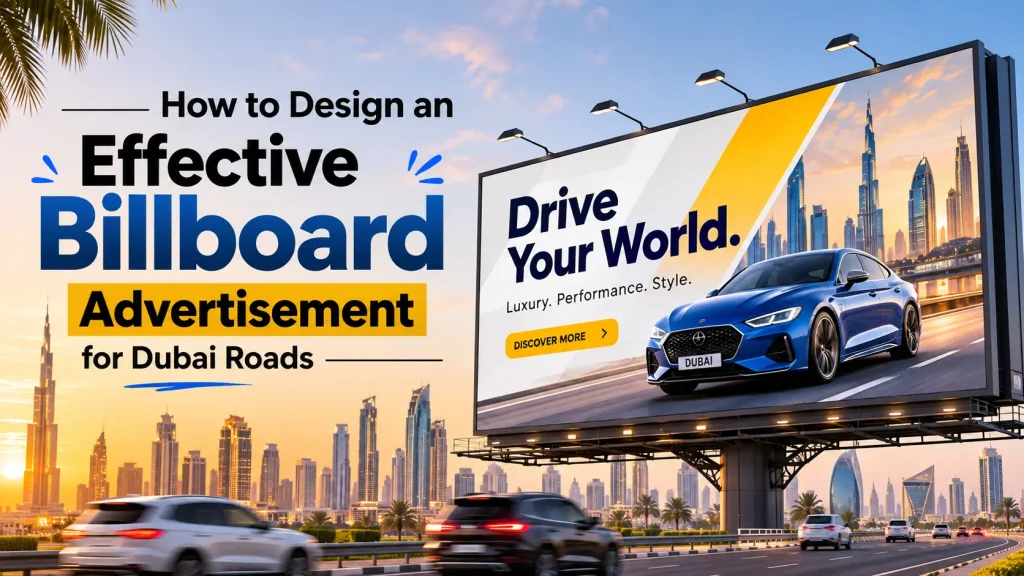
A billboard can give a brand enormous visibility. But simply placing a large advertisement beside a busy Dubai road does not guarantee that people will notice or remember it.
Drivers and passengers have only a short time to see a billboard. They may be travelling through heavy traffic, approaching an intersection or moving past several other advertisements at the same time. This makes billboard design in Dubai very different from designing a social media post, website banner or brochure.
An effective billboard needs to communicate quickly, remain readable from a distance and make the brand easy to remember.
In this guide, we look at the key principles for designing an effective billboard advertisement for Dubai roads, from choosing the right message and visuals to considering viewing distance, location, lighting and local requirements.
Why Billboard Design Matters on Dubai Roads
Dubai has a highly competitive outdoor advertising environment. Major roads and commercial corridors contain billboards, unipoles, digital displays and other forms of outdoor media competing for attention.
The challenge is not simply getting noticed. Your advertisement needs to communicate its main idea before the viewer moves past it.
A good roadside billboard should answer three questions almost immediately:
What is being advertised?
Who is the brand?
What should I remember or do?
If the viewer needs to stop and read several lines of text to understand the advertisement, the design is probably carrying too much information.
1. Start With One Clear Message
The biggest mistake in billboard design is trying to say everything at once.
A business may want to include:
Company name
Product details
Several benefits
Promotional offers
Phone number
Website
Social media handles
Multiple product images
Address
QR code
Putting all of these elements on one billboard can make the design difficult to understand.
Instead, decide on one main message.
For example, instead of:
Luxury apartments in Dubai with premium amenities, flexible payment plans, stunning views and excellent investment opportunities.
A billboard could focus on a simpler idea:
Own Your View of Dubai
The supporting information can be provided through a website, landing page, QR code or sales team.
The billboard’s job is to create awareness and interest. It does not need to function like a brochure.
2. Keep the Headline Short
People do not normally stop to read roadside billboards. They see them while moving.
That means the headline needs to be short enough to understand almost instantly.
A practical starting point is to aim for around five to seven words for the main message, although the ideal length depends on the format, viewing distance and location. Current Dubai OOH guidance and industry design recommendations consistently emphasise short copy and quick comprehension for high-speed roadside environments.
For example:
Too long:
Discover our latest range of premium vehicles with exclusive offers available this month.
Better:
Drive Something Better.
The shorter version leaves more room for the visual and branding while giving the viewer an idea to remember.
3. Use One Strong Visual
A billboard has a large physical area, but that does not mean you need to fill every part of it.
One strong image is often more effective than a collage of several small images.
Your visual could be:
A product
A person
A vehicle
A building
A distinctive brand element
A simple graphic concept
The viewer should immediately understand what the image represents.
For example, an automotive campaign could use one large vehicle image rather than showing five different models in small boxes.
This is particularly important on major Dubai roads, where viewing time is limited.
4. Make the Brand Immediately Visible
Don’t make people search for your logo.
A billboard should make the brand identifiable even when the viewer remembers only part of the advertisement.
Your logo should have:
Sufficient size
Strong contrast
Clear separation from the background
A consistent position within the campaign
However, simply making the logo enormous is not always the answer.
The visual hierarchy should normally guide the viewer through:
Message → Visual → Brand
The exact arrangement depends on the campaign and creative concept.
5. Use High Contrast
A billboard that looks excellent on a computer monitor can become difficult to read outdoors.
Dubai’s strong sunlight, glare, dust and changing lighting conditions make contrast particularly important for roadside advertising. Industry guidance for Dubai OOH design also recommends strong contrast and avoiding visual details that disappear at distance.
For example:
Good:
Dark text on a light background
Light text on a dark background
Clear separation between image and typography
Risky:
Thin white text over a bright photograph
Grey text on a grey background
Small text over detailed imagery
Low-contrast pastel combinations
The design needs to work in the actual environment, not just on your designer’s screen.
6. Design for Viewing Distance
This is one of the most overlooked aspects of billboard design.
A billboard may look perfectly readable when you are standing directly in front of the artwork. But the actual audience may see it from hundreds of metres away.
Before finalising the design, consider:
How far away will people first see it?
How quickly will they approach it?
From what angle will they view it?
How long will it remain in their field of vision?
Is it static or digital?
A design intended for a high-speed road should generally be much simpler than one placed in an environment where people can stand nearby.
Design for the real viewing conditions, not the desktop preview.
7. Consider the Road and Location
The same creative does not necessarily work equally well at every Dubai location.
A billboard beside a major highway has different viewing conditions from a display near a shopping destination or a pedestrian-heavy environment.
For roadside campaigns, consider:
Traffic speed
Traffic volume
Direction of travel
Viewing distance
Billboard height
Surrounding buildings
Other advertising structures
Day and night visibility
Audience profile
For example, a campaign targeting commuters may benefit from a simple message that can be understood while travelling along a major road.
A campaign targeting tourists or visitors may require a different message and creative approach.
Location should influence the design from the beginning, not after the artwork is finished.
8. Design for Day and Night Visibility
Dubai’s outdoor advertising environment remains active after sunset, so your creative should be considered for both daytime and nighttime viewing.
For illuminated or digital formats, check how the design appears under different lighting conditions.
Pay attention to:
Contrast
Brightness
Background colours
Logo visibility
Image clarity
Typography weight
A colour combination that works in bright daylight may look very different at night.
For digital billboards, the creative also needs to work within the available screen format and display duration.
9. Don’t Put Too Much Information on the Billboard
A billboard is not your website.
If people need to read a paragraph to understand the offer, the design needs to be simplified.
Avoid unnecessary:
Long descriptions
Multiple phone numbers
Several URLs
Small disclaimers
Too many product features
Excessive icons
Multiple competing calls to action
Ask yourself:
If someone sees this billboard for three seconds, what will they remember?
If the answer is unclear, simplify the design.
10. Use a Clear Call to Action
Not every billboard needs a complicated CTA.
Depending on your campaign, a simple action may be enough:
Visit us
Book now
Explore more
Scan to learn more
Call today
Visit our website
For roadside advertising, the CTA should remain secondary to the main message.
Also consider whether the action is realistic for the environment.
A QR code may make sense in a pedestrian environment where people have time to scan it. It is much less practical when placed on a billboard viewed by drivers travelling at speed.
11. Consider Arabic and English Carefully
Dubai is a multilingual market, and campaigns targeting a broad local audience may need to consider both Arabic and English.
The design should not treat one language as an afterthought squeezed into an already crowded layout.
Instead, plan the layout for the required languages from the beginning.
This is particularly important because Dubai’s advertising framework includes requirements around advertising content, design and approvals. The applicable requirements can vary according to the advertising format and location, so the final artwork should be checked against the relevant approval requirements.
12. Follow Dubai’s Advertising Requirements
Creative design is only one part of a billboard campaign.
Outdoor advertising in Dubai is subject to regulatory requirements. Dubai’s updated OOH Advertising Manual includes provisions relating to site planning, traffic safety, spacing, design elements, billboard construction and different OOH formats.
Dubai’s advertising regulations also require prior permission from the relevant competent authority before advertisements are displayed. Requirements can include specifications relating to dimensions, duration, advertising method and technical details.
This means businesses should not finalise their creative based solely on aesthetics.
Before production, confirm:
The permitted advertising format
Site-specific requirements
Required dimensions
Technical specifications
Approval requirements
Campaign duration
Installation requirements
Working with an experienced outdoor advertising provider can help ensure that the creative and production process accounts for these requirements.
13. Match the Design to the Billboard Format
Not all outdoor advertising formats should be designed in the same way.
Highway Billboards and Unipoles
Keep the design extremely simple.
Focus on:
One main message
One strong visual
Large branding
High contrast
Digital Billboards
Use motion carefully and make sure the core message works even when viewed as a single frame.
Digital formats can allow changing messages or time-based campaigns, but the creative should still communicate quickly.
Lamp Post Advertising
Because these displays can be encountered repeatedly along a route, the campaign can use consistent branding and short messages across multiple placements.
Pedestrian-Level Displays
These can allow more information because the audience may have more time to engage with the advertisement.
The design should always match the viewing behaviour of the audience.
14. Test the Design Before Printing
Never approve a large billboard design only by looking at it on a laptop.
Before production, test it at a reduced scale.
Look at it from a distance and ask:
Can I read the headline?
Can I identify the brand?
Can I understand the main message?
Does the visual stand out?
Is anything unnecessary?
Does the design still work without zooming in?
You can also test the design on different screens and under different brightness levels, particularly for digital or illuminated formats.
The goal is simple:
If the design only works when you zoom in, it is not ready for a billboard.
Common Billboard Design Mistakes to Avoid
Here are some of the mistakes that can reduce the impact of a billboard campaign:
Too Much Text: Trying to explain everything makes the message difficult to absorb.
Small Logo: A memorable message has little value if people cannot identify the advertiser.
Weak Contrast: Poor contrast can make the advertisement difficult to see in bright sunlight.
Too Many Images: Multiple small visuals can create clutter.
Tiny Contact Details: If a phone number or website cannot be read from the expected viewing distance, it may not add much value.
Designing Without Considering the Location: A creative should be developed around the actual billboard environment.
Treating Every Format the Same: A highway unipole, digital screen and pedestrian display have different viewing conditions.
Ignoring Approvals: An attractive design still needs to meet applicable Dubai advertising requirements before it can be displayed.
A Simple Billboard Design Checklist
Before approving your billboard artwork, ask:
Is there one clear message?
Can the headline be understood quickly?
Is the brand clearly visible?
Is there one strong visual?
Is the text large enough for the viewing distance?
Is the contrast strong?
Does the design work in both day and night conditions?
Does it suit the location and format?
Is the CTA simple?
Have the relevant technical and approval requirements been checked?
If the answer is yes to all of these, your creative is much more likely to work in the real-world environment.
Final Thoughts
Effective billboard advertising in Dubai is not about putting the most information into the biggest possible space.
It is about communicating one strong idea clearly.
A successful billboard combines a short message, strong visual, clear branding, good contrast and a design that suits the location and viewing conditions. It also needs to account for Dubai’s advertising requirements and the specific characteristics of the chosen OOH format.
Whether you are planning a billboard, unipole or another form of outdoor advertising, start with the audience and location before designing the artwork.
Make it simple. Make it visible. Make it memorable.
That is what turns a large advertisement into an effective billboard campaign.