
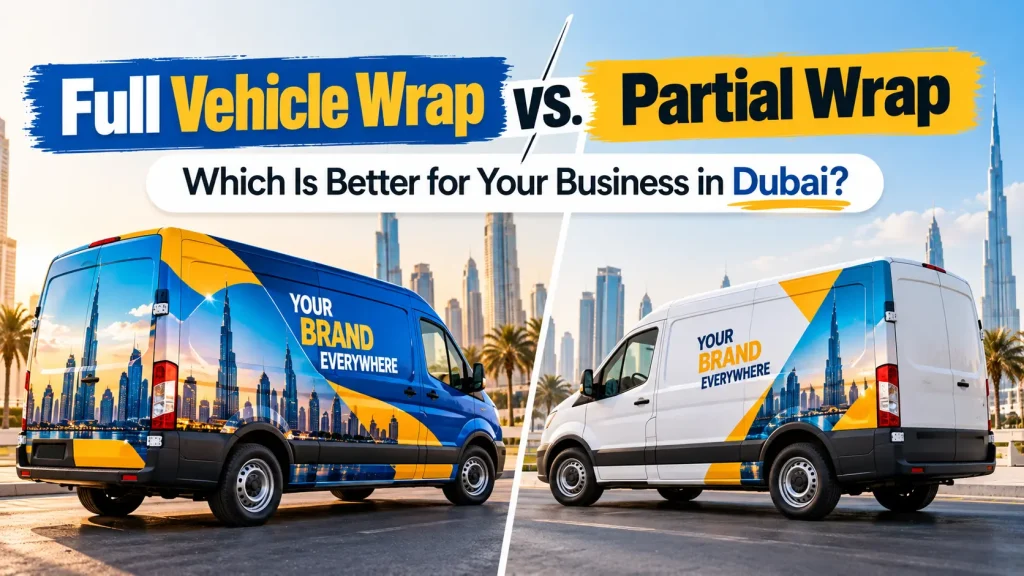
Vehicle branding is a practical way for businesses in Dubai to increase brand visibility while their vehicles travel between customers, offices, commercial areas and project sites. Whether you operate a single delivery van or manage a fleet of commercial vehicles, a well-designed vehicle wrap can turn your vehicle into a moving advertisement.
But should you cover the entire vehicle or brand only selected sections?
A full vehicle wrap offers extensive coverage and more room for creative designs, while a partial wrap can help businesses promote their brand without covering every panel. The right choice depends on your budget, vehicle type, branding goals and how you use your vehicles.
In this guide, we compare full and partial vehicle wraps, explain their advantages and limitations, and help you choose the right option for your business in Dubai.
What Is a Full Vehicle Wrap?
A full vehicle wrap involves covering most or nearly all of a vehicle’s exterior with printed or coloured vinyl. Depending on the design, it can include the doors, side panels, bonnet, rear panels and other suitable surfaces.
Businesses often choose full wraps when they want their vehicles to make a strong visual impression. The larger coverage area provides more space for brand colours, logos, product images, service information and campaign graphics.
For example, a delivery company in Dubai could use a full wrap to display its branding consistently across its vans. A food business might use product photography and bold colours to make its delivery vehicles more recognisable on the road.
Full wraps can work well for individual vehicles and commercial fleets, particularly when brand visibility is an important marketing objective.
What Is a Partial Vehicle Wrap?
A partial vehicle wrap covers selected sections of a vehicle rather than its entire exterior. Common areas include the doors, rear panels, bonnet or a portion of the sides.
Instead of covering every panel, the design uses selected areas to display the business name, logo, contact details, brand colours or promotional message. The vehicle’s original paint remains visible on the uncovered sections.
For instance, a plumbing company could place its logo, phone number and service details on both front doors and use the rear panel for additional branding. A small business with a limited marketing budget could achieve a professional appearance without paying for a full wrap.
Partial wraps can be especially useful when a business wants recognisable branding while keeping the design relatively simple.
Full Vehicle Wrap vs. Partial Wrap: Key Differences
Both options can support vehicle branding, but they differ in coverage, design flexibility, cost and the overall appearance of the vehicle.
| Factor | Full vehicle wrap | Partial vehicle wrap |
|---|---|---|
| Coverage | Covers most or nearly all of the exterior | Covers selected panels or sections |
| Initial investment | Generally higher | Generally lower |
| Design flexibility | More space for detailed, large-scale designs | Best suited to focused branding and simpler messages |
| Brand visibility | Provides extensive branded coverage | Visibility depends on placement and design |
| Original paint visibility | Most wrapped areas are covered | Unwrapped areas remain visible |
| Installation | Usually involves more material and labour | Often requires less material and installation work |
| Best suited for | High-impact branding and prominent fleet presentation | Budget-conscious branding and essential business information |
| Creative possibilities | Large graphics, product imagery and immersive designs | Logos, contact details, colour accents and selected graphics |
The actual cost and installation time depend on the vehicle, vinyl material, surface condition, design complexity and installer. A partial wrap is not automatically the better value if the design fails to communicate your brand clearly.
Which Option Is More Affordable in Dubai?
For many businesses, budget is the first consideration when choosing between full and partial vehicle wraps.
A partial wrap generally costs less because it requires less vinyl and often involves less installation work. It can be a practical choice for businesses that need professional branding but do not require extensive coverage.
A full wrap typically requires more material, printing and labour. Complex designs, difficult vehicle surfaces and premium vinyl can increase the overall cost.
However, there is no single price that applies to every vehicle wrap in Dubai. A compact car, a large delivery van and a commercial truck have different surface areas and installation requirements.
Before requesting a quotation, consider the following cost factors:
Vehicle size and type: Larger vehicles generally require more material and installation work.
Coverage area: Full wraps usually require more vinyl than partial wraps.
Vinyl quality: Different materials have different costs, finishes and expected performance.
Design complexity: Detailed graphics, multiple colours and intricate layouts may require additional preparation and installation time.
Surface condition: Existing damage, difficult contours or unsuitable surfaces may affect preparation requirements.
Installation quality: Experienced installers and careful finishing are important for a clean, durable result.
Removal requirements: Ask whether future removal or replacement is included in the quotation.
When comparing prices, request a breakdown of material, printing, design, installation and any additional charges. This makes it easier to compare proposals on a like-for-like basis.
Full Vehicle Wrap: Advantages and Disadvantages
A full wrap can be a strong choice when your business wants its vehicles to have a consistent and highly visible appearance.
Advantages of a Full Wrap
1. Greater design space
A full wrap gives designers more room to use brand colours, graphics, product images and campaign visuals. This can help create a distinctive appearance that people can recognise.
2. Strong brand presentation
Covering most of the vehicle allows the design to feel more cohesive. This is useful for businesses that want their vehicles to reflect an established brand identity.
3. Suitable for prominent campaigns
Businesses promoting a new product, service or major campaign may benefit from the additional space available for creative messaging.
4. Potential surface protection
Quality vinyl can help protect covered paintwork from some minor surface abrasion and everyday exposure. However, a wrap is not a substitute for paint protection film, and the level of protection depends on the material, installation and vehicle condition.
Disadvantages of a Full Wrap
1. Higher upfront cost
More material and installation work usually mean a higher initial investment than a comparable partial wrap.
2. More installation work
Wrapping complex vehicle shapes and multiple panels takes time. The installation process may require the vehicle to remain at the workshop for longer.
3. More design decisions
Covering more of the vehicle creates more opportunities for visual impact, but the design must remain clear and consistent. Too many graphics or messages can make the branding difficult to understand.
4. Greater replacement coverage
If you change your brand identity or campaign, a larger area of vinyl may need to be replaced. The actual cost depends on the revised design and the condition of the existing wrap.
Partial Vehicle Wrap: Advantages and Disadvantages
Partial wrapping offers a simpler approach to business vehicle branding. It can be effective when the main goal is to make the business name, logo and contact information easy to identify.
Advantages of a Partial Wrap
1. Lower initial investment
Because it covers fewer panels, a partial wrap generally requires less vinyl and installation work.
2. Focused branding
A carefully positioned logo, brand colour and contact number can communicate essential information without covering the entire vehicle.
3. Flexible design options
Partial wraps can work with the vehicle’s existing paint colour. Designers can use the original finish as part of the overall design rather than covering it completely.
4. Practical for small businesses
Businesses with one or two vehicles can establish a professional branded appearance without committing to the cost of a full wrap.
5. Useful for growing fleets
Companies that are gradually expanding their fleet may find partial branding easier to implement across different vehicle models, provided the designs are planned consistently.
Disadvantages of a Partial Wrap
1. Less space for creative messaging
A smaller coverage area limits how much information and imagery can be included. The design needs to prioritise the most important details.
2. Results depend heavily on placement
If the logo or contact information is placed on an area that is difficult to see, the wrap may have limited impact.
3. The original paint remains visible
The uncovered panels retain their existing colour and condition. If the vehicle’s paint is faded or inconsistent, the overall appearance may be less uniform.
4. Limited coverage of the paintwork
Only the wrapped sections receive the surface protection provided by the vinyl. Uncovered panels remain exposed to normal wear and environmental conditions.
Which Is Better for Different Types of Businesses in Dubai?
The right option depends on how your vehicles are used and what you want your branding to achieve.
Delivery and Logistics Companies
Delivery and logistics companies often use their vehicles throughout the working day, travelling between warehouses, commercial districts, residential areas and customer locations.
A full wrap can help create a consistent, recognisable fleet identity, especially when vehicles are a prominent part of daily operations. A partial wrap can also work well when the company mainly needs its logo, service details and contact information to be visible.
For businesses operating multiple vans, consistency across the fleet may be more important than choosing the same coverage level for every vehicle.
Restaurants and Food Businesses
Restaurants, catering companies and food delivery businesses can use vehicle branding to promote their name, products and delivery services.
A full wrap offers more room for food photography, brand colours and campaign graphics. It may suit businesses that want their vehicles to function as prominent moving advertisements.
A partial wrap can be sufficient for smaller operations that mainly need to display their logo, delivery service and contact details.
Home Maintenance and Service Companies
Businesses offering plumbing, electrical work, cleaning, pest control and other home services often need customers to identify their vehicles quickly.
A partial wrap featuring a clear logo, service category and contact number can be effective for this purpose. A full wrap may be worth considering when the company wants a stronger visual identity across a larger fleet.
Whichever option you choose, make sure the essential business information remains readable.
Retail and E-commerce Businesses
Retailers and e-commerce companies can use branded vehicles to increase recognition while transporting products or making deliveries.
A full wrap may suit brands with distinctive packaging, strong visual identities or product imagery that benefits from a larger display area. Partial branding can be a practical alternative for businesses prioritising their logo and website or contact details.
Real Estate and Property Businesses
Real estate companies may use vehicle branding to improve brand recognition across the areas they serve. A simple partial wrap can display the company logo and contact information, while a full wrap can support a more prominent campaign.
If your business regularly changes promotional messages, consider how easily the design can be updated and whether a reusable branding approach would be more suitable.
How Dubai’s Climate Affects Your Vehicle Wrap Choice
Dubai’s climate is an important consideration when selecting vehicle wrapping materials and planning long-term maintenance.
Vehicles may experience intense sunlight, high temperatures, dust and frequent exposure to outdoor conditions. These factors can contribute to fading, adhesive deterioration or edge lifting over time, depending on the vinyl quality, installation and vehicle use.
The size of the wrap does not determine its durability by itself. Both full and partial wraps can perform well when the right materials are selected and installed correctly.
Before choosing a wrap, consider these points:
Choose suitable vinyl: Ask your installer which material is appropriate for your vehicle and intended use.
Prioritise installation quality: Proper surface preparation and careful application help reduce problems around edges, curves and recessed areas.
Follow cleaning instructions: Use cleaning methods recommended by the vinyl manufacturer or installer.
Inspect exposed areas: Check edges, corners and high-wear areas periodically for lifting or damage.
Park in shaded areas where practical: Reducing prolonged direct sun exposure may help maintain the wrap’s appearance.
If durability is a major concern, read our guide on how long vehicle wrapping lasts in Dubai’s climate.
How to Choose Between a Full and Partial Wrap
Before making a decision, evaluate your vehicle, budget and marketing objectives. The following steps can help you narrow down the options.
1. Set Your Budget
Decide how much you can invest in vehicle branding without compromising other marketing priorities. Compare full and partial wrap quotations for the same vehicle so you can understand the cost difference.
If you manage a fleet, ask whether the supplier can provide a consistent design and pricing proposal for all the vehicles.
2. Define Your Main Objective
Think about what you want the vehicle to achieve.
If you need a strong visual presence and extensive brand coverage, a full wrap may be suitable. If your priority is simply to make your business name and contact information visible, a partial wrap may be enough.
3. Consider the Vehicle’s Existing Colour
The original paint colour can influence the design. A partial wrap may look particularly effective when the existing colour complements your brand palette.
If the colour clashes with your brand identity, a full wrap may provide greater flexibility to create a consistent appearance.
4. Evaluate Your Daily Routes
Consider where the vehicle travels and how people are likely to see it. Vehicles that spend considerable time on roads, at customer locations or in busy commercial areas may provide more opportunities for brand exposure.
However, visibility alone does not guarantee results. The design should make your business easy to recognise and communicate the most important message quickly.
5. Plan for Future Changes
If your business frequently changes its logo, offers or promotional campaigns, consider how easily the wrap can be updated.
A partial wrap may be simpler to modify when only a small section contains campaign-specific information. A full wrap can still work well, but future redesigns may involve replacing a larger amount of material.
6. Choose an Experienced Installer
The quality of the final result depends on more than the design. Material selection, surface preparation, application technique and finishing all matter.
Ask to see previous projects involving similar vehicles. Confirm the material specifications, warranty conditions, expected installation time and care instructions before proceeding.
Common Mistakes to Avoid When Choosing a Vehicle Wrap
Whether you select a full or partial wrap, avoid these common mistakes.
Choosing based only on price: The cheapest quotation may not include the same material quality, preparation or installation standards as other proposals.
Including too much information: A moving vehicle is not the right place for lengthy descriptions. Prioritise your logo, core service, contact details or one clear message.
Ignoring the vehicle’s shape: A design that looks good on a flat screen may not work as well across curved panels, door gaps and vehicle contours.
Using inconsistent branding: Different vehicles should follow a recognisable design system, especially when they are part of the same fleet.
Overlooking maintenance: Even quality vinyl needs appropriate care. Ignoring cleaning instructions or failing to address lifting edges can affect the wrap’s appearance.
Forgetting applicable approvals: Before displaying commercial vehicle advertisements in Dubai, confirm the applicable requirements and approvals for your vehicle and proposed branding. Requirements may vary depending on the vehicle and the nature of the advertisement.
Final Verdict: Full Wrap or Partial Wrap?
Neither option is automatically better for every business.
A full vehicle wrap is worth considering when you want extensive coverage, a distinctive appearance and more space for creative branding. It can be particularly suitable for businesses whose vehicles play a prominent role in their marketing.
A partial vehicle wrap may be the better choice when you want clear, professional branding at a lower initial cost. It can work well for small businesses, service providers and companies that mainly need their name, logo and contact information to stand out.
Before deciding, compare the costs, review the design on your actual vehicle model and consider how the branding will support your business over time.
The goal is not simply to cover more of the vehicle. It is to create branding that makes your business recognisable and communicates the right message wherever your vehicles go.
Get Vehicle Branding for Your Business in Dubai
At Ahlan Advertising, businesses can explore vehicle branding solutions based on their vehicles, branding requirements and budget. Whether you need a full wrap for a high-impact design or a partial wrap for focused business branding, the right approach starts with understanding your objectives.
Contact Ahlan Advertising to discuss your vehicle branding requirements and find a solution that suits your business.